
How to Design Packaging for Costco: The Complete Structural Packaging Guide
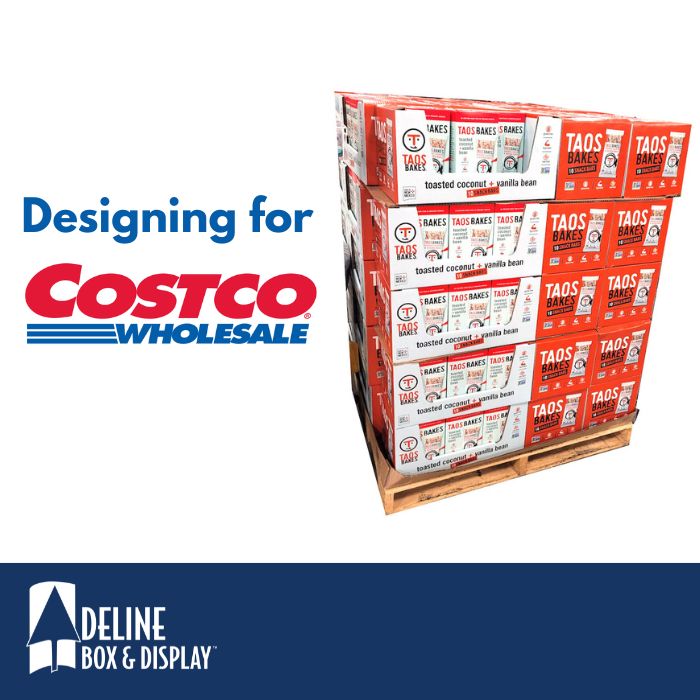
If you sell — or want to sell — at Costco, your packaging is graded on a standard most CPG brands have never had to meet: it has to survive a 25-foot stack, a 2,300 psi mechanical clamp, a year in storage, and still look good enough to sell itself on the floor. Miss the mark and you’re not just risking damaged product — you’re risking a 2% chargeback or outright item rejection.
At DeLine Box & Display, we’ve spent four generations engineering corrugated packaging and retail displays for CPG brands moving into club store, retail, and ecommerce channels — including brands navigating Costco’s Structural Packaging Specifications for the first time. This guide breaks down what Costco actually requires, where new vendors most often get it wrong, and how to design packaging that passes compliance review on the first try.
Quick answer: Costco packaging must be engineered to survive long-haul transit, repeated mechanical clamping up to 2,300 psi, 80–90% humidity, a minimum of four weeks’ storage (up to one year for ecommerce), and stacking to 25 ft — all while shipping display-ready with no box cutters or extra labor required to stock it. Pallet loads must fit a 48″ x 40″ footprint with zero overhang, and dynamic stacking strength must hold 1,500–2,500 lbs on the bottom layer depending on load weight.
Below, we walk through every major requirement — and where we’d push the design further.
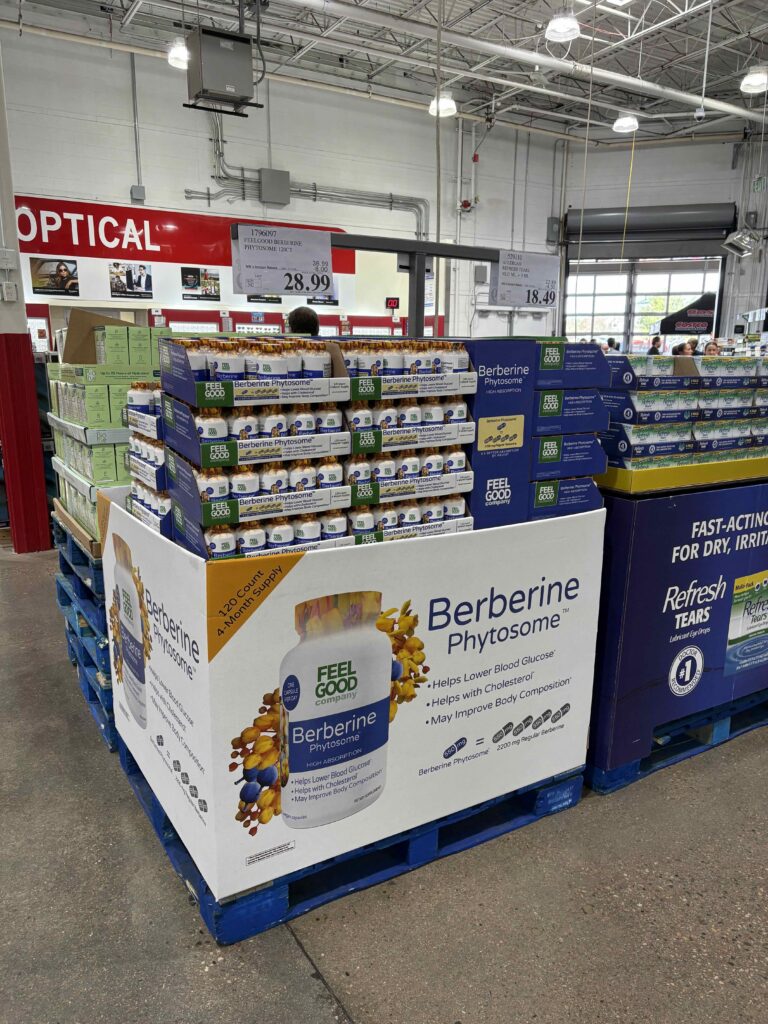
1. Design for Costco’s Supply Chain, Not Just the Truck
Most packaging engineering starts and ends with “will it survive shipping.” Costco’s supply chain asks more of your box than that. Product may be:
- Clamped two-way or four-way by mechanical clamp trucks at Costco’s depots, with clamp panels pressing on either the 40″ or 48″ sides
- Multistacked in cooler or freezer storage
- Stacked up to 25 ft in ecommerce distribution centers, for as long as one year
- Merchandised on end caps and focus displays at only 6 ft of stacking height, regardless of how tall the inbound unit load was
Design insight: Because clamp direction isn’t guaranteed, we engineer flute orientation and case strength to perform under compression from either the 40″ or the 48″ side — not just the direction that tested best in the lab. This single decision is one of the most common points of failure we see in first-time Costco packaging designs.
2. Get the Pallet Footprint Right
This is where the most preventable rejections happen.
- Unit load footprint: no larger than 48″ x 40″, no smaller than 45″ x 37″
- Recommended footprint: 47″ x 39″
- Zero overhang is allowed in any direction; underhang can’t exceed 3″
- No gaps between sell units or master cartons — the pallet area must be maximized
- Chimney stacking is prohibited — every column must be supported top to bottom
- False bottoms with empty space are not allowed unless Costco specifically requests it
Design insight: We reverse-engineer the pallet layout before finalizing sell unit dimensions, not after. A case that’s a fraction of an inch off can turn a clean 48-count column stack into a wasted-cube layout with unsupported gaps — which fails Costco’s stacking strength requirement even if the corrugate itself is strong enough.
3. Meet the Dynamic Stacking Strength Numbers
- Pallet loads under 750 lbs (including pallet) must hold 1,500 lbs on the bottom layer without damage
- Pallet loads 750 lbs or more must hold 2,500 lbs
- Loads must maintain that strength during end-cap merchandising at 6 ft, regardless of inbound stack height
- Factor in the environmental stack: 80–90% humidity, four weeks minimum storage (up to a year for ecommerce)
Conventional edge-crush testing often doesn’t predict real-world sales floor failures — Costco says as much in its own spec. Nesting failures, in particular, tend to show up on the floor, not in the lab.
4. Build for “Display-Ready,” Not “Ship-Ready”
This is the requirement that separates a shipping box from real retail-ready packaging (RRP), and it’s where a lot of standard corrugated suppliers fall short on club store work.
Costco requires:
- No box cutters, no labor to stock product
- No tear front panels, plastic strapping, tear tape, telescoping lids, or tray covers (with narrow exceptions for layer-quantity distribution)
- Trays sized to a minimum of five sell units per layer, to support reuse as Front End carry-out boxes
- A minimum 3″ front panel height (down to 2″ only for specific product height exceptions)
- Anti-nesting features so an empty tray can’t collapse into the one below it
- Max weight of 40 lbs per tray, with 25 lbs recommended
Design insight: Costco explicitly reuses emptied trays at checkout as member carry-out boxes. We treat this as a second design brief, not an afterthought — the tray’s front-facing graphics, structural rigidity, and handle-ability need to work for two completely different audiences: warehouse stockers and the member walking out the door with it.
5. Sell Unit & Blister Packaging Materials
Costco has tightened its stance on plastic packaging significantly:
- Clamshells and blister-box packaging are not allowed
- Card-and-blister (trapped blister) is preferred, and requires written buyer approval
- Rigid PVC is not acceptable
- All materials should be widely recyclable, compostable, or biodegradable
- Expanded polystyrene is banned except in narrow, buyer-approved cases
- Costco is actively working to eliminate PFAS across products and packaging
Design insight: This is where paper-based and corrugated alternatives to plastic clamshells earn their keep — not just for compliance, but because Costco’s own buyers are visibly steering suppliers toward them. If your current packaging leans on rigid plastic, budget design time now rather than after a rejection.
6. Know Your Department’s Modifications
Costco layers department-specific addendums on top of the base spec. A few that trip up new vendors:
- Liquor: Beer packaging needs functional carry handles or side-access holes. Wine/spirits trays must cover 50–65% of bottle height, with removable, glue-free dividers.
- Cooler/Freezer: Requires Moisture Resistant Adhesive (MRA), double-wall construction, and wide stacking surfaces — single-wall raw edges fail fast in a moist, refrigerated environment.
- Produce: Triple-wall bulk bins, stacking tabs capped at 0.75″, and specific pulping/temperature protocols at trailer loading.
- Candy: Date coding required in “Best Before mm/dd/yy” format, minimum 0.375″ font, on two sides plus the front of every tray.
If you’re expanding into a new department at Costco, don’t assume last year’s base spec covers you — check the current addendum every time.
7. Don’t Underestimate Pallets Themselves
Costco has moved decisively toward pooled pallet programs:
- iGPS, PECO, or CHEP block pallets are required throughout North America
- Stringer/GMA pallets and CHEP Euro pallets are not accepted
- Purpose-built pallets require pre-approval and are only permitted for oversized goods
- International shipments require ISPM 15 heat-treatment, with marks on both 48″ sides
This is a compliance category vendors often leave entirely to a broker — worth confirming directly, since a rejected pallet means a rejected delivery, and the supplier owns that cost regardless of who arranged freight.
8. Build in a Testing Buffer Before You Ship
Costco is explicit that it does not provide structural approval of packaging — that responsibility sits entirely with the supplier. ISTA pre-shipment testing is strongly recommended but doesn’t guarantee a damage-free supply chain on its own, because the club environment (clamp trucks, sales-floor nesting, nine-month cooler storage) isn’t fully replicable in a standard lab protocol.
Design insight: For new item launches, we recommend a short-run prototype pass before committing to full production tooling — something our DeLine Digital sub-brand, running a Barberán Jetmaster single-pass inkjet press, is built for. It lets a brand see and physically stress-test real display graphics and case strength on a handful of units before investing in a full print run, which matters most exactly when a buyer’s compliance window is tight.
Common Reasons Costco Packaging Gets Rejected
- Pallet footprint exceeds 48″ x 40″ or leaves gaps between cases
- Chimney stacking or unsupported columns
- Tray fails to meet minimum front panel height
- Clamshell or rigid PVC packaging used without approval
- Missing MRA on cooler/freezer packaging
- Pallets not on iGPS, PECO, or CHEP
- Packaging requires a box cutter or extra labor to stock
Any one of these can trigger a chargeback or item deletion — and most of them are catchable at the design stage, before a single unit ships.
Why Work With a Packaging Engineer Who Knows Club Store Design
Costco’s own specification says it plainly: a packaging engineer “with specialization in both unit load and Costco’s sales floor” should be involved before you finalize design. That’s a narrower skill set than general corrugated design — it means understanding clamp truck mechanics, pallet pooling programs, department-specific addendums, and how a tray behaves after 200 uses as a Front End carry-out box, not just how it performs in a drop test.
That’s the work we do every day for CPG brands moving into Costco, Sam’s Club, and other club store and retail channels — from structural engineering and pallet layout through display-ready graphics production.
Looking for a Costco packaging supplier who already speaks this language? Talk to DeLine Box & Display about your next Costco item.
FAQ: Designing Packaging for Costco
What size must a Costco pallet load be? No larger than 48″ x 40″, no smaller than 45″ x 37″, with a recommended footprint of 47″ x 39″. Overhang is not permitted.
How much weight must Costco packaging support? Pallet loads under 750 lbs must withstand 1,500 lbs on the bottom layer; loads of 750 lbs or more must withstand 2,500 lbs — without damage.
Does Costco allow clamshell packaging? No. Clamshells and blister-box packaging are not allowed. Card-and-blister (trapped blister) packaging is preferred and requires written buyer approval.
What pallets does Costco accept? iGPS, PECO, or CHEP block pallets throughout North America. Stringer/GMA and CHEP Euro pallets are not accepted, and purpose-built pallets require pre-approval.
Does Costco approve packaging structurally? No. Costco reviews packaging for aesthetics only. Suppliers are fully responsible for structural integrity and compliance throughout the supply chain.
What happens if my Costco packaging fails compliance? Non-compliant items may be refused, deleted from the system, or subject to a 2% chargeback to cover Costco’s added handling costs.
DeLine Box & Display is a fourth-generation, family-owned corrugated packaging and display manufacturer based in Denver, Colorado, serving CPG brands nationally. This guide reflects Costco’s publicly available Structural Packaging Specifications as of 2025–2026; always confirm current requirements with your Costco buyer, as specs and department addendums are updated regularly.
